How Polymarket works
Polymarket buyers take Yes or No shares from other traders. The price is the chance, and the winning side redeems for $1.
- Price = probability
- Redeem $1 or $0
- Sell before the end
- Makers pay $0
Review / How it works
What is Polymarket and how does it work
Polymarket traders buy shares from other people, not from a house. Each Polymarket share is priced from $0 to $1. A Polymarket price of $0.65 means the market is pricing that outcome at about 65%. Polymarket 101, checked 22 Nov 2026, is the source for the $1 payout and the $0 loss.
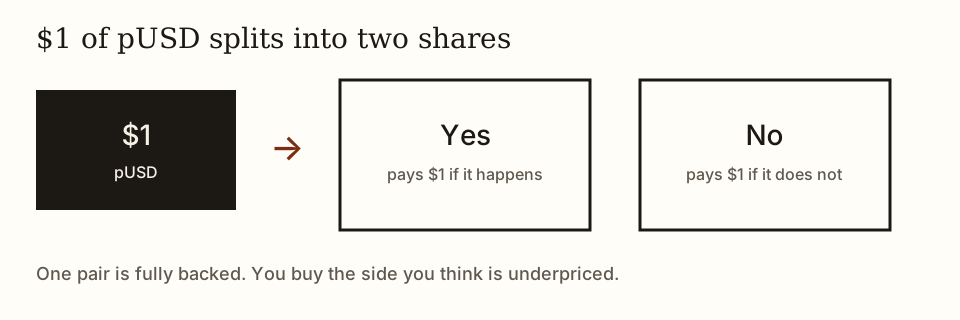
- $1 of pUSD collateral creates one Yes share and one No share.
- You buy the side you think the market has priced too low. The price is the probability.
- A correct share redeems for $1. A wrong share redeems for $0. You can sell the share before the event ends.
| Action | When |
|---|---|
| Buy Yes | You think the chance is higher than the price |
| Buy No | You think the chance is lower than the price |
| Sell | You want to lock a gain or cut a loss before resolution |
| 100 shares | Gross result, before the taker fee |
|---|---|
| Buy Yes at $0.40 | Pay $40. Yes wins: redeem $100. Yes loses: redeem $0. |
| Buy No at $0.40 | Pay $40. The event does not happen: redeem $100. |
| Sell those Yes shares at $0.55 | Receive $55. Locked gain $15 if you paid $40. |
The number on a Polymarket market
Polymarket does not set the price. Polymarket prices come from bids and asks. The displayed Polymarket price is the midpoint of the best bid and the best ask. If the spread is wider than $0.10, Polymarket shows the last traded price instead.
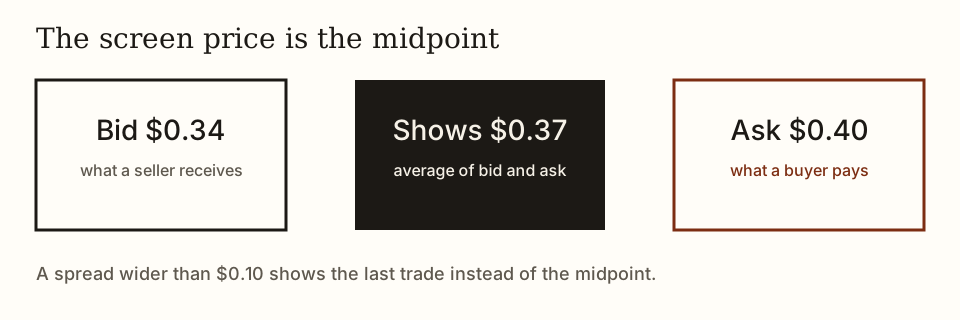
On Polymarket, a best bid of $0.34 and a best ask of $0.40 display as $0.37. Buying 100 Polymarket shares pays $40, not $37. On a Polymarket market with taker rate 0.05, the fee on that buy is 100 × 0.05 × 0.40 × 0.60 = $1.20. Polymarket publishes no maximum order size. A large Polymarket order walks the book and can pay worse prices than the first ask, so Polymarket says to read the depth before trading size.
| Order | What it does |
|---|---|
| Buy now | Pays the lowest ask and takes shares that are already resting. You pay the spread. This is the taker side. |
| Sell now | Receives the highest bid. Also a taker trade. |
| Limit | Sits on the book at your price or better. It can fill in pieces. You can cancel what is left. A resting order is the maker side, and the maker fee is $0. |
Every Polymarket order is a limit order. The Polymarket button that fills immediately is a limit priced to cross the book now. A Polymarket order can fill in part, and the rest can be cancelled. Polymarket matches the order off the chain, then settles it on the chain. Custody stays with the wallet until that settlement.
Split, merge, and redeem on Polymarket
A Polymarket position is the balance of one outcome. Most Polymarket positions are opened by buying on the book. The same pUSD can be split into both sides, merged back, or redeemed after Polymarket resolves the market.
| Action | What moves |
|---|---|
| Split | $1 of pUSD becomes one Yes and one No. 100 pUSD becomes 100 Yes and 100 No. |
| Trade | Buy or sell one side on the book. This is how most positions are opened. |
| Merge | Equal Yes and No amounts turn back into pUSD, without waiting for a buyer. |
| Redeem | After resolution, a winning share pays its payout. A full win is $1. A loss is $0. |
Polymarket position value before the end is the share count times the current price. 100 Yes shares at $0.75 are worth $75 on that mark, not $100. A binary Polymarket market can resolve to a split payout, so each side redeems for its share instead of a clean $1 or $0. On a Polymarket negative-risk market, exactly one outcome takes the full payout and the others pay nothing.
Polymarket's positions docs state a 4.00% annualized Holding Reward on eligible markets. Position value is sampled once an hour at random, and the reward is paid daily. The rate is variable and Polymarket can change it. It does not stop a losing share from redeeming at $0.
How a Polymarket market resolves
Polymarket lets a holder sell before the end or hold through resolution. Resolution is how the held Polymarket share turns into $1 or $0. Markets that use the UMA optimistic oracle follow the four steps below. Polymarket Protocol V2 markets can use other resolution rules.
- A proposer submits the outcome with a bond.
- A challenge window stays open.
- If someone disputes it, UMA decides the resolution on markets that use the optimistic oracle.
- Winning shares then redeem for $1 of pUSD. Protocol V2 markets can use other resolution rules.
Until the winning shares are redeemed, a finished Polymarket market can still count as a position. Polymarket refuses account deletion while positions or tokens remain, which is why redemption matters on the delete-account steps.
Polymarket fees while you trade
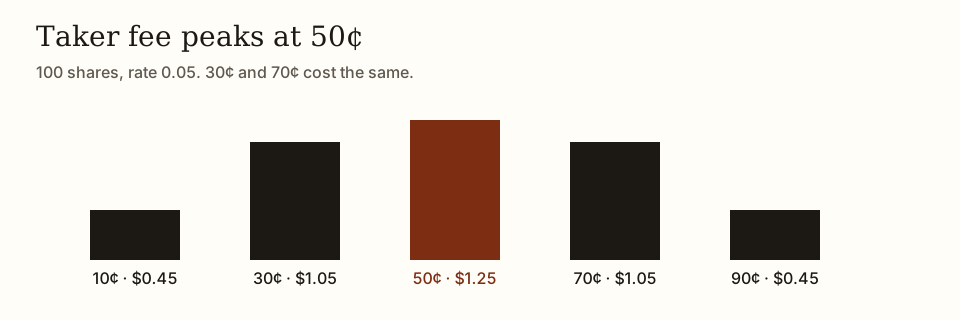
Polymarket charges makers $0. Polymarket takers pay shares × rate × price × (1 − price). Polymarket rounds that fee to 5 decimal places in USDC, and anything smaller than 0.00001 USDC rounds to zero, so a tiny trade near $0.01 or $0.99 can owe nothing. The rate table below is from Polymarket's fee docs, checked 22 Nov 2026.
| Cost | Amount |
|---|---|
| Maker fee | $0. A maker leaves an order resting on the book. |
| Taker fee | shares × rate × price × (1 − price). A taker matches immediately. |
| Highest taker fee | At a 50¢ price. 30¢ and 70¢ cost the same dollar fee. |
| Geopolitics markets | Rate 0. Polymarket does not charge a fee on these markets. |
| Polymarket deposit or withdrawal fee | $0. A bridge, exchange, or on-ramp can still charge its own fee. |
| Category | Taker rate | Fee at 50¢, per share |
|---|---|---|
| Crypto, 5-minute and 15-minute | 0.05 | 1.25¢ |
| Other crypto | 0.01 | 0.25¢ |
| Sports, finance, tech, election politics, combos, other | 0.05 | 1.25¢ |
| Other politics, mentions, economics, culture, weather | 0.01 | 0.25¢ |
| Geopolitics | 0 | $0 |
A Polymarket taker fee at rate 0.05 on 100 shares at 50¢ is 100 × 0.05 × 0.50 × 0.50 = $1.25. The same 100 Polymarket shares at 65¢ cost 100 × 0.05 × 0.65 × 0.35 = $1.14. Rate 0.01 is one fifth of those amounts. Polymarket geopolitics stays at $0.
Polymarket charges every combo the combo rate, 0.05, no matter which categories the legs come from. The leg rates do not apply. Those taker fees fund the Polymarket Maker Rebates Program, paid daily in pUSD. Combos and fee-free trades earn no maker rebate. Takers can earn a portion back through the tiered Taker Rebate Program. Polymarket never charges makers.
How cash gets into Polymarket
Polymarket deposits convert to pUSD on Polygon, which is the collateral the account trades. Polymarket publishes no deposit or withdrawal fee of its own. The Polymarket Deposit screen shows the live minimum for the token selected. The bridge docs, checked 22 Nov 2026, list the floors below. If the Polymarket screen shows a higher number, the screen wins.
| Chain | Documented minimum |
|---|---|
| Polygon, Base, Arbitrum, Optimism, BNB, Solana | $2 |
| Ethereum | $7 |
| Bitcoin and Tron | $9 |
Send Polymarket only a supported token on the network the Deposit screen names. A transfer on the wrong chain is not reversed by a Polymarket support email. Recovery, when Polymarket offers it, starts at recovery.polymarket.com for funds sent to the profile address rather than the deposit address.
Polymarket account wallets deployed on or after 4 May 2026 use a Deposit Wallet. Older Magic or Google accounts may still be on a Proxy Wallet, and older external-wallet accounts on a Safe.
If a Polymarket trade does not behave
A Polymarket order that looks wrong is usually a resting maker order, the wrong side, an open dispute, or a fee that peaks at 50¢. Each case has a different next step.
- The order sits open. You posted a maker order. It fills only when someone takes it, and the maker fee is $0.
- You bought the wrong side. Sell into the book if there is a bid. There is no undo button.
- The market is disputed. The challenge window is still running. Redemption waits until the outcome is final.
- The fee looks larger than the rate table. Check the price. The dollar fee peaks at 50¢ and shrinks toward both ends.
No account yet? Polymarket login takes Google, an email code, or a wallet. The Polymarket app page explains why an APK is the wrong install.
Polymarket mechanics in short
Polymarket prices a share from $0 to $1, and a winning share redeems for $1. Polymarket makers pay $0. Polymarket takers pay shares × rate × price × (1 − price), with the dollar fee highest at 50¢. Deposit floors and fee rates were checked 22 Nov 2026.
Questions
How does Polymarket work?
Polymarket buyers take Yes or No shares from other traders, and the price is the market's probability. A winning Polymarket share redeems for $1, and a losing share redeems for $0. The share can be sold before the event ends.
What is Polymarket and how does it work if I am wrong?
A wrong Polymarket share redeems for $0. The share can be sold earlier if the Polymarket price still has a bid. Polymarket has no house that sets the odds.
Does Polymarket charge a deposit fee?
Polymarket does not charge a deposit or withdrawal fee. A Polymarket taker still pays a trading fee on most markets, and geopolitics markets have a zero rate. Polymarket makers pay $0.
Can I sell Polymarket shares before the event ends?
Yes. Polymarket shares can be sold into the bid before resolution. Equal Yes and No amounts can also be merged back into pUSD. Redemption waits until Polymarket marks the outcome final.
Mechanics: Polymarket 101. Order book: Prices and order book. Positions and the holding reward: Positions and tokens. Fees: Polymarket fee docs. Deposit floors: Polymarket bridge supported-assets docs. Checked 22 Nov 2026.